
What your smartphone is made of, and its toll on the planet
About three quarters of the world's cobalt is mined in Congo, and nearly four fifths of its natural graphite in China. Most of a smartphone's climate impact is created in the factory, before it reaches a shop.

You look at it dozens of times a day. Inside are copper, gold, cobalt, tantalum and rare earths, mined in a handful of countries and passed through a long supply chain before they become a phone.
What elements are in a smartphone
The chemist and science communicator Andy Brunning, in his project Compound Interest, broke the phone down by component:
- Screen: aluminosilicate glass, covered with an ultra-thin film of indium tin oxide, transparent and conductive: it is what senses your finger.
- Processor: ultra-pure silicon, "doped" with traces of other elements such as phosphorus, boron or gallium.
- Circuits: mostly copper, gold and silver. Tantalum makes up the micro-capacitors, palladium shows up in the components, and the solder is tin with silver and copper.
- Battery: lithium-ion. The positive electrode is often a lithium cobalt oxide, the negative one is graphite, and the casing is aluminium.
- Speakers and vibration: magnets of neodymium, iron and boron, with a little dysprosium and praseodymium, three rare earths. The little motor that makes the phone vibrate uses a tiny tungsten weight.
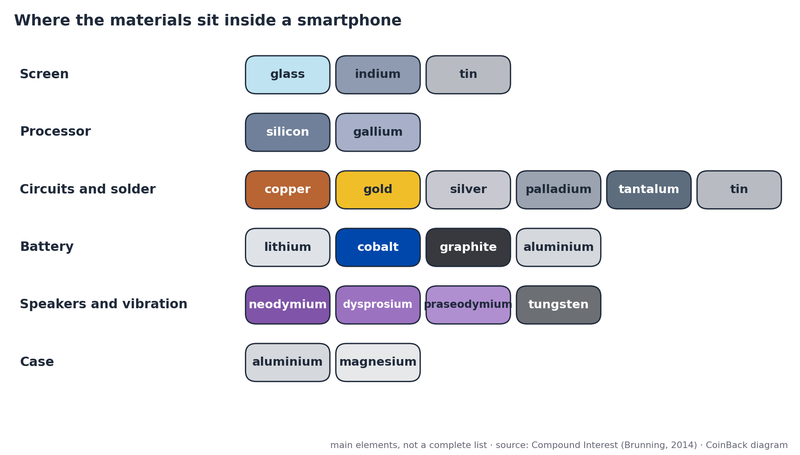
Every part of the phone has its own elements (source: Compound Interest, Brunning 2014, CoinBack diagram).
Many of these elements are present in minute amounts, but more than a billion phones are made every year. According to the GSMA, the worldwide association of mobile operators, they account for about 10% of global cobalt demand.
Where cobalt, lithium and graphite come from
For some of these minerals, mining is concentrated in very few countries. These are the 2024 figures collected by the USGS, the US geological survey:
- Cobalt: 220,000 tonnes out of 290,000 come from the Democratic Republic of the Congo, about three quarters of the total.
- Natural graphite: China mines 79% of it.
- Tantalum: the top producer is the Congo again (42%), followed by Nigeria and Rwanda.
- Lithium: it is more spread out, with Australia at 37%, Chile at 20% and China at 17%.
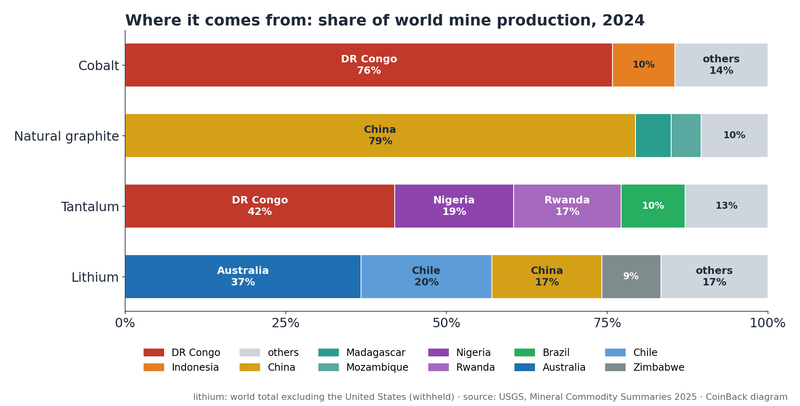
A few countries mine most of a phone's minerals (data: USGS, Mineral Commodity Summaries 2025, CoinBack diagram).
The journey from mine to factory is long: the minerals have to be concentrated, refined, turned into components and finally shipped to assembly plants. The GSMA points out that extracting and processing raw materials can have strong local impacts on biodiversity, land use and water, as well as on the health of the people living nearby.
How much does a smartphone pollute
In its report Rethinking Mobile Phones (2025), the GSMA collected the life-cycle studies on smartphones. Manufacturing typically accounts for 70 to 90% of a phone's climate footprint. Transport and distribution add 4 to 8%, while charging ranges from almost zero to 20% depending on the country's electricity grid. Disposal stays under 1%.
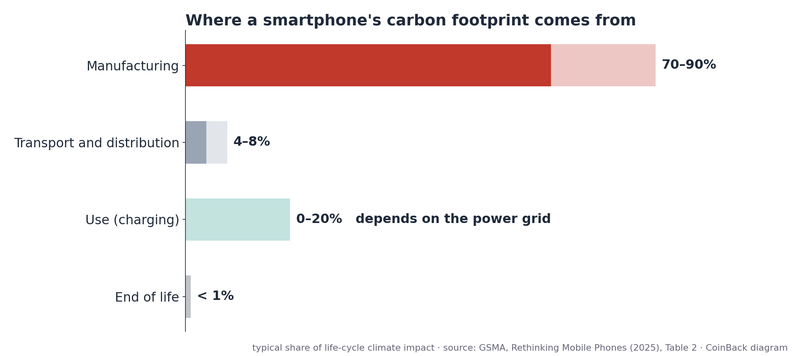
Almost all of the climate footprint is created before the phone reaches your hands (data: GSMA 2025, CoinBack diagram).
When you open the box, about 80% of that phone's emissions has already been produced. The heaviest part is the integrated circuits, the chips, which take a huge amount of energy to make. According to the GSMA, making around 1.5 billion phones a year emits about 65 million tonnes of CO₂ equivalent, roughly what Morocco or Romania emit in a year.
Disposing of it properly still matters, because metals are recovered and hazardous substances stay out of the environment. For the climate, though, what counts far more is how often we buy a new phone.
How long does a smartphone last, and how long should you keep it
Worldwide, people now replace their phone on average every three and a half years; ten years ago it was about two. According to the GSMA, the most common reasons are a battery that no longer holds up, a phone that slows down and physical damage.
On damage, there are figures from the United States. In surveys by Allstate Protection Plans (2023, published in March 2024), 31% of smartphone owners had damaged a phone in the previous twelve months. Among the problems reported, a broken screen was by far the most common (67%), and 38% of those who had damaged their phone then replaced it. It is a different market, but it gives an idea of how many phones are retired after an accident.
A study cited by the GSMA (Sánchez and colleagues, 2024) calculated that using the same phone for five years instead of three cuts its annual climate footprint by about 30%, even after counting a battery replacement. A refurbished phone, according to the French ecological transition agency ADEME, has a climate impact of about 10% of a new one.
Over fifteen years the sum is simple. Someone who changes phone every three years buys five; someone who changes every five years buys three: 40% fewer new phones, and the same goes for batteries. It is arithmetic, not a market statistic.
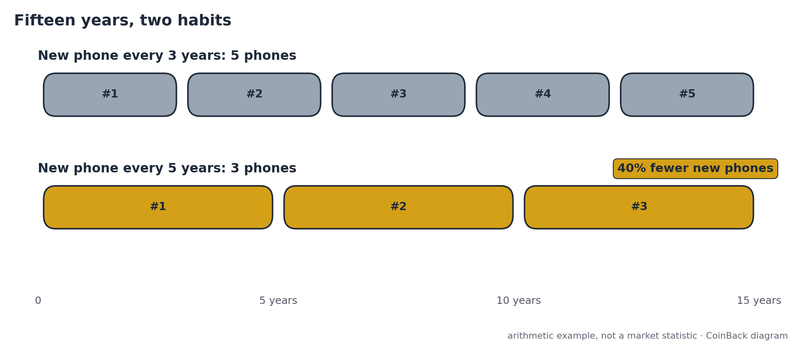
Two habits over fifteen years: an arithmetic example, not a market statistic (CoinBack diagram).
A study by the European Environmental Bureau (EEB, 2019) did the sum for the whole Union: extending the life of all European smartphones by one year would avoid about 2.1 million tonnes of CO₂ a year by 2030. It is a projection based on a collective scenario, not a saving already achieved.
How to recycle a smartphone
The EPA, the US environmental protection agency, reports a USGS estimate: from one million recycled mobile phones we recover about 16 tonnes of copper, 350 kg of silver, 34 kg of gold and 15 kg of palladium.
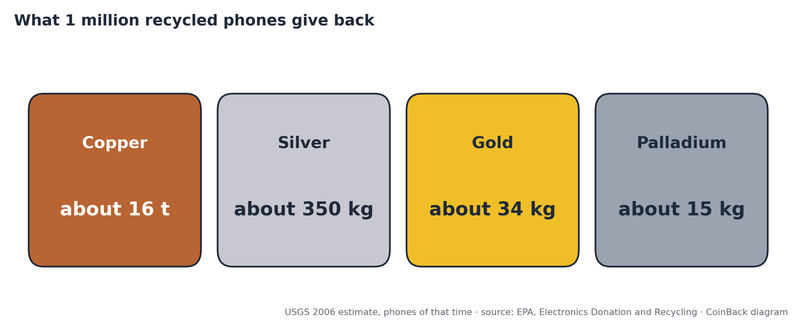
Metals recoverable from one million mobile phones, USGS estimate from 2006 (source: EPA, CoinBack diagram).
The estimate dates from 2006 and covers the phones of that time: a present-day smartphone has a different composition. Either way, the metals recovered don't have to be mined again.
Few phones actually reach recycling. According to the United Nations' Global E-waste Monitor, in 2022 the world produced a record 62 million tonnes of electronic waste, 80% more than in 2010. Only one fifth of small IT equipment, phones included, was collected and recycled through proper channels. The GSMA estimates that around 10 billion unused phones are sleeping in drawers around the world.
How to recycle a lithium battery
A spent lithium-ion battery still contains its lithium. In specialised plants, batteries are made safe, dismantled and treated with mechanical and chemical processes that recover lithium, nickel, cobalt and copper for new batteries. A battery should never go in the general waste: materials are wasted and it can catch fire.
According to the International Energy Agency (IEA), recycled nickel, cobalt and lithium produce on average 80% lower emissions than the same materials taken from mines. In the scenario that reflects governments' climate pledges, by 2050 recycling would cut the need for new lithium and nickel mines by 25%, and for copper and cobalt by 40%. These are figures on materials, not on the whole phone.
The European Union has set precise targets. The Regulation (EU) 2023/1542 on batteries requires recyclers to recover at least 50% of the lithium by the end of 2027 and 80% by the end of 2031; for cobalt, nickel and copper the thresholds are 90% and then 95%. In 2026 the Commission confirmed that these targets remain adequate.
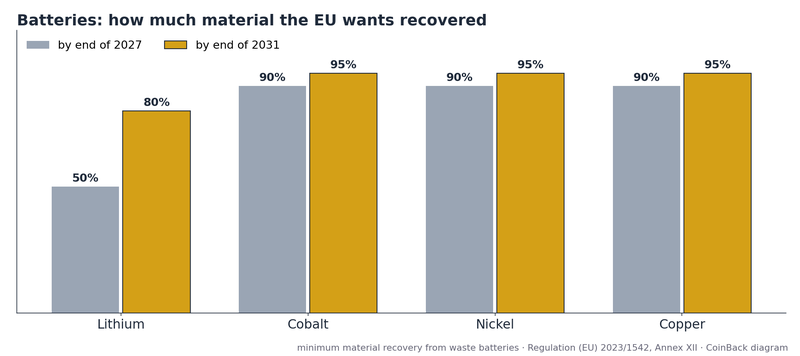
Minimum material recovery targets for end-of-life batteries (EU Regulation 2023/1542, CoinBack diagram).
How to make your phone last longer
The screen is what breaks most often, and a case with tempered glass costs far less than a new screen, so fit both as soon as the phone is out of the box. If after a couple of years the battery barely lasts the day, you can replace just the battery; a broken screen can usually be repaired too.
If you decide to replace it, a refurbished phone weighs much less on the climate. The old one can be sold, given away or handed back through shop and operator take-back schemes instead of sitting in a drawer. When it no longer works, take it to an e-waste collection point or to a shop that accepts old phones.
You can find more product deep-dives in Dive in.
Sources
- GSMA (2025). Rethinking Mobile Phones: The business case for circularity
- GSMA (2026). Mobile Device Circularity: Key Facts and Figures for the Mobile Industry
- Brunning A. (2014). The Chemical Elements of a Smartphone. Compound Interest
- U.S. Geological Survey (2025). Mineral Commodity Summaries 2025: cobalt, lithium, graphite, tantalum
- Allstate Protection Plans (2024). 78 million Americans damaged their smartphones in the last year. Press release of 14 March 2024
- European Environmental Bureau (2019). Coolproducts don't cost the earth, briefing
- U.S. EPA. Electronics Donation and Recycling (USGS data, 2006)
- IEA (2024). Recycling of Critical Minerals, executive summary
- Regulation (EU) 2023/1542 concerning batteries and waste batteries, Annex XII, Part C