
Hedera Network
CBK, the token CoinBack uses to reward your purchases, lives on the Hedera network.

What is Hedera? Where does it come from? How is it different from Bitcoin or Ethereum? And above all, why choose Hedera for CBK? These are some of the questions you might be asking yourself, and today we'll try to find the answers.
Why does CBK use Hedera?
The Hedera network uses an innovative algorithm that settles transactions in just a few seconds, in an extremely cheap and environmentally friendly way: it is in fact one of the few cryptocurrencies with a carbon-neutral footprint.
All this translates into a minimal cost for every transaction: $0.001, fixed and predictable.
Ethereum and Bitcoin need tens, if not thousands, of times as much energy for each transaction, and you never know exactly when it will go through (maybe in half an hour, maybe tomorrow) or how much it will cost you.
The Hashgraph algorithm
The idea is very simple: imagine that, while chatting, Francesco tells you a piece of gossip, “Marco has proposed to Giulia”, which you immediately pass on to your friend Stefania.
There is also gossip about the gossip: yesterday, in fact, Francesco told you he heard it from Giovanni, who found out the day before from Rebecca and Giuseppe, who in turn had heard it from Marco himself three days ago.
So you know not only about the proposal, but also who knows about it. In fact, if there are 10 friends in your group, you can be sure of what at least 8 of them know: if they are asked “When did we hear about Marco's proposal to Giulia?”, you know how they will answer.
Now, once you know that at least two thirds of your group know about the proposal, you can also work out, without asking anyone, when the news reached the group: the day before yesterday. You're already a day late to go and congratulate Marco.
Who governs Hedera: the Hedera Council

One table, many different chairs: governance shared among organisations (CoinBack illustration, AI-generated).
The Hedera Council is like our group of friends deciding, fairly easily, how to spend the evening: the cinema, a fancy dinner or, say, an impromptu party at Marco's, who is enjoying his last days as a bachelor. By comparison, other decentralised networks look more like a nightclub, where groups of organisers have to compete and coordinate with each other to run a packed room.
No single company controls the network. The Hedera Council's rules allow up to 39 members (today there are about thirty), each serving a fixed term, which gives the network's rules stability and predictability. Members include IBM, Deutsche Telekom, Tata Communications and Google.
The history of Hedera
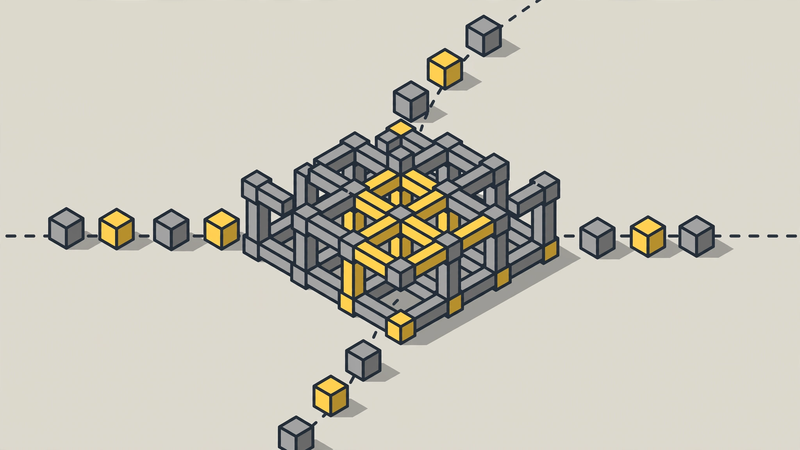
Many contributors, one shared codebase (CoinBack illustration, AI-generated).
- The Hedera network begins with the hashgraph algorithm at its core, developed between 2012 and 2016 by Leemon Baird.
- On 31 May 2016 Baird publishes the whitepaper “The Swirlds Hashgraph Consensus Algorithm: Fair, Fast, Byzantine Fault Tolerance” for Swirlds, the company he co-founded.
- In 2017, after its first funding round, Swirlds sets up Hedera Hashgraph, LLC, a Delaware company.
- In 2018 the project takes the name Hedera and mints its native cryptocurrency, HBAR.
- On 24 August 2018 the mainnet goes live and 50 billion HBAR are minted.
- In 2019 the first members of the governing council are announced; the council meets for the first time in Seoul.
- On 16 September 2019 the mainnet opens to everyone.
- On 13 February 2020 the Hedera Consensus Service arrives: a kind of digital postmark that gives any message a certain date, time and order.
- On 6 August 2020 the code of the network services becomes open source, meaning public and reusable, under the Apache 2.0 licence.
- On 9 February 2021 comes the Hedera Token Service, for creating tokens directly on the network.
- On 2 February 2022 the Smart Contract Service arrives, for programs that run on the network.
- In early 2022 the council votes to buy the rights to the hashgraph algorithm from Swirlds for 292,682,666.87 HBAR, about $76.3 million at the exchange rate of the time.
- On 5 August 2022 the hashgraph platform also becomes open source, under the same licence.
- In September 2024 Hedera donates its entire source code to LF Decentralized Trust, the Linux Foundation's new organisation for distributed ledgers: this is how the open source project “Hiero” is born.
From whitepaper to public network
Today hashgraph orders the transactions of a public network open to everyone. This is the network where CoinBack's CBK live: discover our partner shops and the CBK rewards each one offers.
Sources
- Leemon Baird, The Swirlds Hashgraph Consensus Algorithm, Swirlds, 31 May 2016
- Hedera, Hedera's Journey (official timeline)
- Hedera Docs, Gossip about gossip and Virtual voting
- Hedera Council, FAQ and About
- Hedera, A New Era for Hedera, 8 May 2025
- Hedera, Hedera is open source as Hiero
- LF Decentralized Trust, Hello Hiero!, 17 October 2024
- Wikipedia, Hedera (distributed ledger)