
What time is it on a crypto network?
What time is it on a crypto network? It sounds like a silly question, yet it is the most important one.

Every event on a crypto network carries a label, the timestamp: date and time, like a station clock. It is the thread that ties the event to the physical world. But what really matters is something else:
When the event happened compared with all the others.
No clock reads this kind of time. It is an internal property of the network, and the network builds it by itself.
Before or after, not “what time”
Picture the queue at the post office. All you need to know is who was ahead of whom: the order matters, not the exact time each person arrived.
Double spending is the practical reason. If you try to spend the same digital coin twice, in two different shops, the network doesn't need to know what time you paid, but which payment came first: the second one must be rejected. Without a shared order, digital money would be copied like a file.
The blockchain is a clock
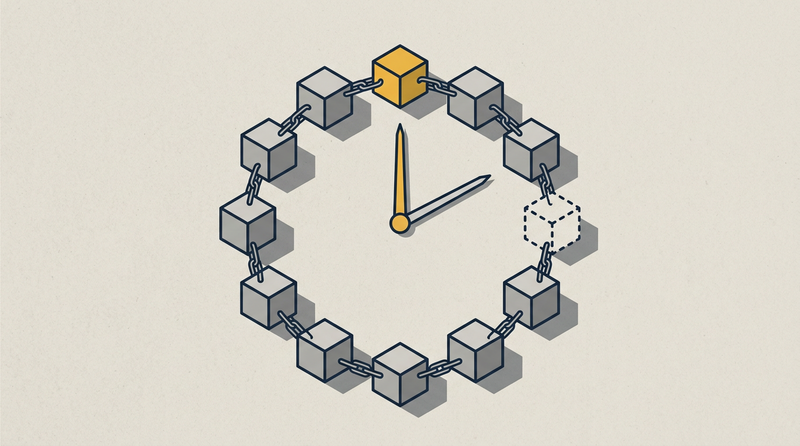
Each block carries the fingerprint of the previous one: the chain ticks off time like a clock hand (CoinBack illustration, AI-generated).
The simplest example is the blockchain, the “chain of blocks”. At heart it is a clock: every block is a tick.
The transactions in a block all happen at that moment, sharing the block's own timestamp. They don't get mixed up, because inside the block each has its own place: simultaneous, but ordered.
A clock hand can't reach 3 without passing through 2: the before and the after are written into the structure of the clock.
The blockchain works in the same way: each block contains the “fingerprint” (in jargon, the hash) of the previous block, a seal that locks its content. So you can't change one block without invalidating all the ones that follow.
The when depends on the block, not on the clock
On Bitcoin, imagine you have breakfast at a café at 9 and pay 10,000 satoshi (a satoshi is one hundred-millionth of a bitcoin).
At 11 you buy a fruit juice at the supermarket and pay 3,000 satoshi.
For the chain, though, the time you paid doesn't matter: what matters is which payment gets into a block first.
If the payment at the café is left waiting and the juice goes through first, as far as the network is concerned the juice came before the cappuccino and croissant. If at the start of the day you only had 11,000 satoshi in your wallet, the barista won't see anything arrive.
Hedera and the DAG: not a chain, but a web of events
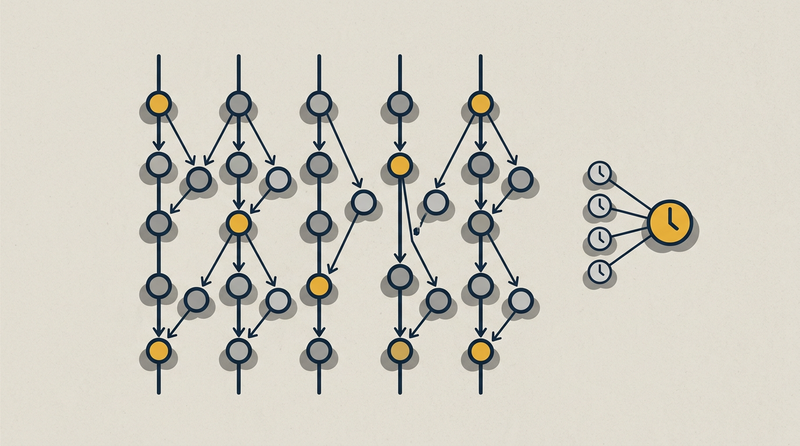
In the hashgraph every event points to two previous events; the consensus time is the median of the nodes' clocks (CoinBack illustration, AI-generated).
Hedera, the network where CBK lives, took a different road. Remember the gossip about Marco's proposal to Giulia, in the history of Hedera? When you pass the news on to Stefania, you bring two memories with you: the last thing you said yourself and what you just heard from Francesco. Everything stays tied to two earlier things, in a network where everyone is constantly talking to everyone else.
Not a single file any more, but a spider's web. It is called a DAG, a directed acyclic graph: arrows that always point towards the past and never towards the future. From this web, and from the rumours the nodes have exchanged, the network works out a single order, valid for everyone.
The twist: the consensus timestamp
And yet, after all this philosophy, there is a surprise: Hedera brings the physical clock back on stage.
Every computer in the network notes down when it heard about your payment. The time in the middle, the median, becomes the official time for everyone: this is the consensus timestamp. A wrong or lying clock isn't enough to shift it.
Had you paid on Hedera, the 9 o'clock breakfast would have come before the 11 o'clock juice, just as in real life, and the barista would have been paid in about 3-5 seconds.
Time as agreement
In the end, on a network time isn't discovered: it is agreed. There is no great clock in the sky dictating it, but a pact among many participants about what comes first and what comes after.
CBK, CoinBack's token, is born inside this agreement. Discover the partner shops and the CBK rewards each one offers.
The idea, by the way, is almost fifty years old. In 1978 the computer scientist Leslie Lamport wrote that in a distributed system there is no single time for everyone: there is the relation “This happened before That”. If I write to you and you reply, the reply comes after the message, whatever our clocks say. If, on the other hand, two events cannot have influenced each other, asking which came first has no answer: for Lamport they are “concurrent” events.
Sources
- Leslie Lamport, Time, Clocks, and the Ordering of Events in a Distributed System, Communications of the ACM 21(7), July 1978
- Satoshi Nakamoto, Bitcoin: A Peer-to-Peer Electronic Cash System, 31 October 2008
- Bitcoin Wiki, Block timestamp and Difficulty
- Hedera Docs, Gossip about gossip and Hashgraph consensus algorithms
- Hedera Docs, Introduction (finality)
- Hedera, What is hashgraph consensus?